
The Engineer’s Guide to Extending Concrete Pump Delivery Pipe and Elbow Lifespan

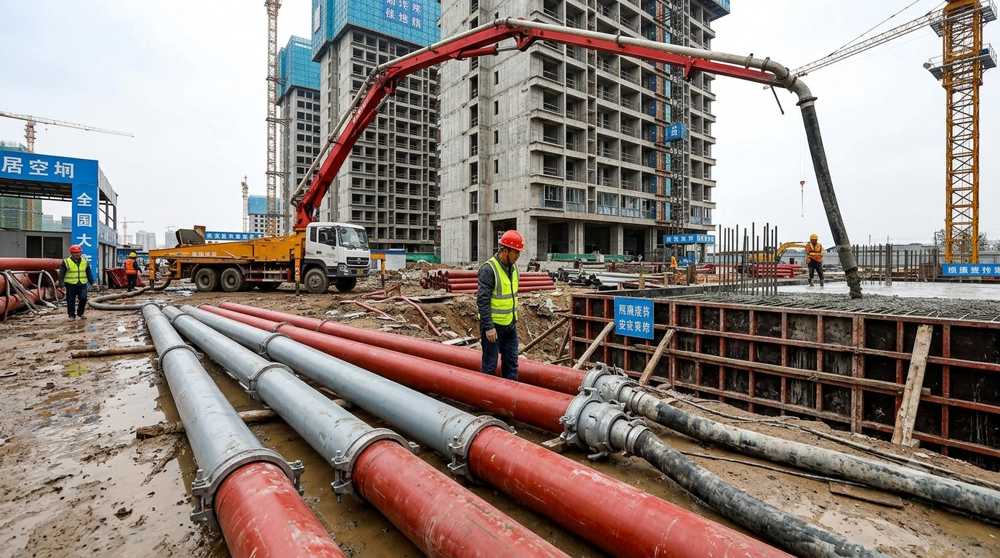
In high-pressure concrete pumping operations, the concrete delivery pipeline and boom elbows are subjected to continuous, extreme abrasive wear. Concrete is a highly abrasive composite slurry slurry. As coarse gravel, sharp river sand, and cement paste are forced through the pipe under extreme hydraulic pressure—often exceeding 8.5 MPa (1,232 psi)—they act as a continuous grinding wheel against the inner steel walls.Pipeline failure, especially a pipeline blowout mid-pour, causes major operational issues. Not only does it halt construction and waste expensive ready-mix concrete, but it also creates severe safety hazards on the job site. For fleet managers and concrete pumping contractors, minimizing operational costs means maximizing the lifespan of these wear components.This engineering guide analyzes the metallurgy of concrete pumping pipes, maps wear patterns in elbows, and provides data-backed maintenance strategies to double your pipeline service life.
1. Metallurgy and Pipe Classifications: Single-Wall vs. Twin-WallSelecting the right pipeline material is the baseline for controlling your wear budget. Pumping pipes are broadly classified into two categories based on their internal metallurgy:
[Single-Wall Pipe] ──► Solid ST52 Steel ──────────► Hardness: HB200-230 ──► Lifespan: 15,000 m³
[Twin-Wall Pipe] ──► Steel Outer + High-Cr Inner ──► Hardness: HRC60-65 ──► Lifespan: 60,000 m³
Single-Wall Pipes (Standard Grade)Standard single-wall pipes are typically manufactured from ST52 carbon steel or 45Mn manganese steel.
- Hardness Rating: ST52 steel exhibits a Brinell hardness of approximately HB200 to HB230.
- Performance Metrics: A standard 4.5mm or 5.0mm single-wall ST52 pipeline has a typical service lifespan of 15,000 to 20,000 cubic meters of standard C30 concrete pumping before the wall thickness drops below safe operating limits.
- Application: Best suited for low-pressure ground line pumping or stationary setups where concrete volume is low and cost-efficiency per pipe is the primary constraint.
Twin-Wall Pipes (Premium Heavy-Duty Grade)Twin-wall (dual-layer) pipes are engineered specifically for truck-mounted boom pumps with high volumetric outputs. They consist of a high-strength outer structural steel jacket and a highly specialized, induction-hardened inner wear liner.
- Inner Liner Metallurgy: The inner layer is usually composed of high-chromium cast iron alloys or specialized manganese-chrome steel matrices.
- Hardness Rating: Through specialized liquid quenching and heat treatment, the inner liner achieves a Rockwell hardness rating of HRC60 to HRC65 (equivalent to over HB650).
- Performance Metrics: Premium twin-wall pipelines (such as a 4.5mm inner + 2.5mm outer shell configuration) routinely achieve a service life of 50,000 to 80,000 cubic meters.
2. Analyzing the Fluid Mechanics of Pipeline Wear PatternsWear inside a concrete pumping line is never uniform. Fluid dynamics dictate exactly where and why steel degrades faster.The Friction ZonesIn a straight horizontal line, concrete moves via plug flow. The concrete matrix forms a thin, lubricated boundary layer of cement paste against the pipe wall, while the thick aggregate core moves together in the center.
- If the concrete mix is properly proportioned, straight horizontal pipes experience minimal wear.
- However, if the concrete mix segregates (separates) or has a very low slump, the boundary layer collapses. Coarse gravel scrapes directly against the bottom half of the pipe wall, creating asymmetric bottom wear.
The Impact Zone: Boom Elbows (90° and 45° Bends)Elbows experience the most destructive wear in the entire pumping system. When the direction of the high-velocity concrete stream changes suddenly, the centrifugal force throws heavy, coarse aggregates directly against the outer curve radius of the elbow bend.

This creates a localized abrasion zone known as sliding erosion. Boom elbows placed close to the pump discharge outlet (the transition zone from the S-valve) experience the highest kinetic impact and typically fail 3 to 4 times faster than straight deck pipes.
3. Engineering Maintenance Strategies to Double Pipeline LifespanTo maximize your return on investment (ROI) on pump parts, you must implement a structured preventive maintenance protocol.Strategy A: The 180-Degree Pipe Rotation TechniqueBecause gravity forces heavy aggregates to settle toward the bottom of horizontal pipes during pumping, the bottom 120-degree arc of a straight pipe wears down twice as fast as the top arc.
- The Procedure: Fleet managers should implement a mandatory pipeline rotation schedule every 5,000 cubic meters of concrete pumped.
- The Execution: Unclamp the straight pipe segments, rotate them exactly 180 degrees along their longitudinal axis, and re-clamp them. This shifts the thick, unworn top section of the pipe to the bottom friction zone, effectively doubling the usable volume capacity of a single pipe segment.
Strategy B: Ultrasonic Wall Thickness MonitoringNever wait for a pipe to burst to replace it. A pipeline blowout under 100 bar of pressure can damage the boom structure and cause severe injury.
- The Tool: Use a portable Ultrasonic Thickness Gauge (UT Gauge).
- The Metric: A standard 125mm (5-inch) ID boom pipe starts with a wall thickness of 4.5mm or 7.0mm (depending on single/twin-wall spec). Once ultrasonic readings show that the wall thickness has degraded to below 2.0mm at any point, the pipe must be scrapped immediately as it can no longer safely withstand high-pressure hydraulic spikes.
4. Operational Factors: Concrete Slump and Priming ProtocolsHow your operators run the pump directly affects structural wear.The Role of Slump and Mix Design
- Low Slump Concrete (<100mm): Requires extremely high hydraulic pumping pressure to push through the line, drastically accelerating internal pipe abrasion.
- High Silt/Clay Content: Sand with high clay content absorbs water, drying out the boundary lubricating layer and causing heavy friction.
- Optimized Slump: Maintaining a consistent slump between 160mm and 200mm ensures a smooth cement boundary layer, reducing friction against the pipe walls.
The Critical Importance of Proper PrimingPumping dry concrete into a dry pipeline at the start of a shift causes immediate scratching and line blockages.
- The Protocol: Always prime the pipeline using a specialized polymer priming agent or a rich cement-sand slurry (1 bag of cement mixed with water and sand).
- The Mechanism: This primer coats the inner liner of the entire line, establishing the boundary paste layer before the heavy structural concrete aggregates enter the system.
Technical Component Reference TableUse this specification matrix to match your pumping job requirements to the correct pipeline grade:markdown
Concrete Pumping Pipeline Grade Selection Matrix
| Pipeline Class / Type | Material Composition | Inner Layer Hardness | Average Volumetric Lifespan | Best Applied For |
|---|---|---|---|---|
| Standard Single-Wall | ST52 Carbon Steel | HB200 - HB230 | 12,000 – 15,000 m³ | Ground lines, small trailer pumps |
| Hardened Single-Wall | 45Mn / 65Mn Manganese | HB300 - HB400 | 20,000 – 25,000 m³ | Mid-sized stationary line pumps |
| Standard Twin-Wall | ST52 + High-Mn Inner | HRC55 - HRC58 | 35,000 – 45,000 m³ | Standard truck boom pumps (under 37m) |
| Premium Twin-Wall | Q235 + High-Chromium | HRC60 - HRC65 | 60,000 – 80,000 m³ | High-output long boom pumps (47m–63m) |
Use code with caution.
Sourcing Wholesale High-Wear Pumping ComponentsReplacing your delivery lines with the correct metallurgical grade is vital to keeping your pumping fleet profitable.If your company operates fleet machinery (such as Putzmeister, Schwing, Sany, or Zoomlion pumps) and requires direct factory pricing on induction-hardened twin-wall pipes, reinforced 90-degree elbows, heavy-duty wedge clamps, or rubber sealing gaskets, our logistics network can assist. We connect construction companies directly with certified metallurgical manufacturers in industrial hubs to provide heavy-duty components at wholesale prices with worldwide container freight shipping
Request Technical Blueprints & Factory Quotes
Submit your machinery parameters below. Connect directly with verified, certified heavy industrial manufacturers to receive custom foundation drawings, layout schematics, and direct-from-factory pricing.