
Sany vs. Putzmeister: Which Concrete Pump Has Better ROI?
Sany vs Putzmeister concrete pump comparison. We analyze upfront costs, pumping technology, maintenance, and resale value to find the best long-term ROI.

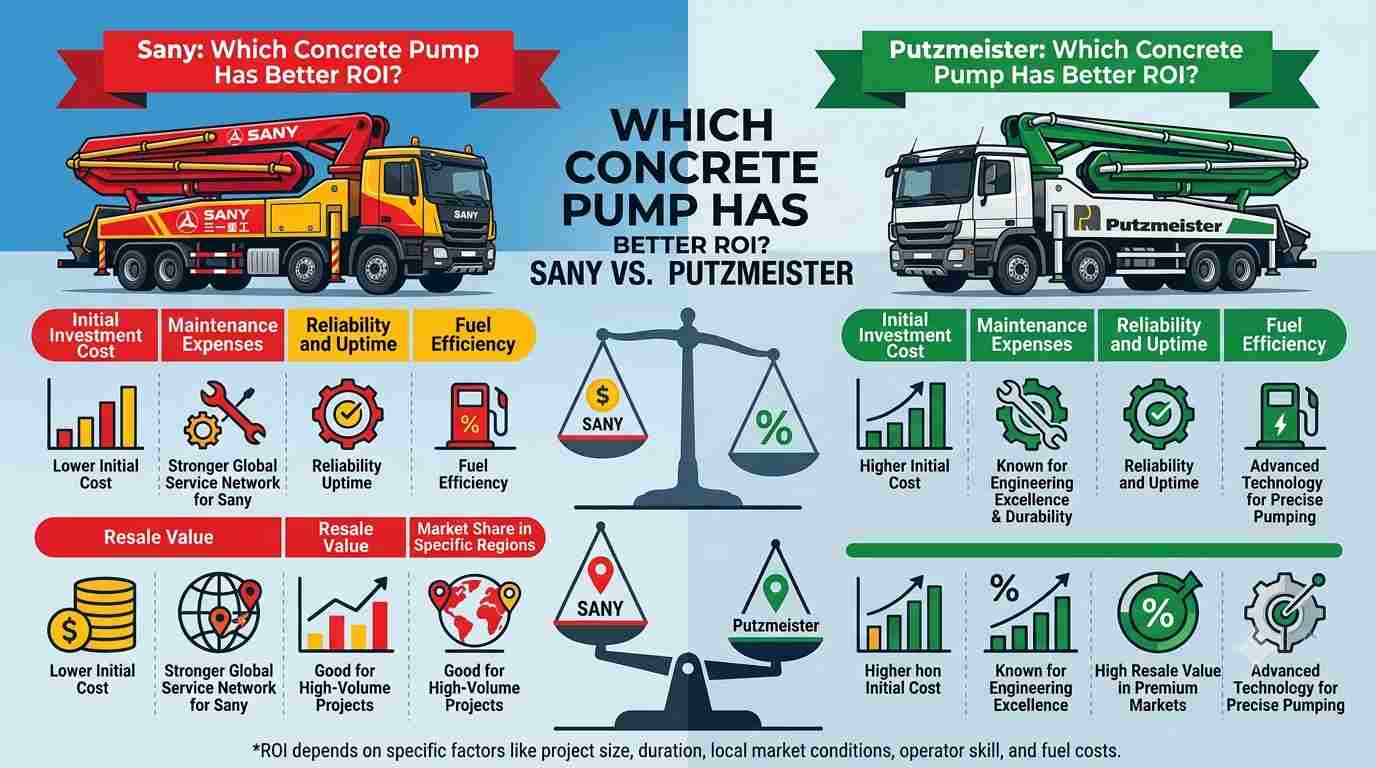
In the concrete pumping and construction industry, choosing the right machinery is one of the biggest financial decisions a contractor will make. When it comes to concrete pumps—whether truck-mounted boom pumps or stationary line pumps—two heavyweights dominate the global market: Sany and Putzmeister.Since Sany acquired Germany’s Putzmeister in 2012, the two brands have shared technologies, yet they still maintain distinct brand identities, engineering philosophies, and price points.For fleet owners and contractors in North America, Europe, Asia, and Africa, the ultimate question is not just which machine costs less upfront, but which brand delivers the highest long-term Return on Investment (ROI)?This comprehensive comparison breaks down their technology, durability, resale value, and maintenance costs to help you make the right profitable choice.
1. Initial Investment vs. Upfront CostWhen calculating ROI, the initial purchase price is your starting point. This is where the paths of Sany and Putzmeister diverge significantly.
- Putzmeister (The Premium Standard): Manufactured with German engineering precision, Putzmeister pumps command a premium price tag. Buyers are paying for decades of proven reliability, advanced steel metallurgy, and a high-status brand name that engineering clients trust.
- Sany (The Value Leader): Sany offers highly competitive pricing, making it incredibly attractive for growing contractors or businesses operating in emerging markets across Africa and Southeast Asia. Sany leverages massive economies of scale to offer advanced features at a lower entry barrier.
The ROI Verdict: If upfront cash flow is your biggest constraint, Sany wins. However, a lower purchase price only contributes to a higher ROI if the machine stays out of the workshop and on the job site.
2. Core Technology and Pumping EfficiencyBoth brands offer exceptional pumping technology, but they handle the mechanics differently.Putzmeister: The Ergonic® AdvantagePutzmeister is famous for its Ergonic® Output Control (EOC) and boom control systems. This technology automatically regulates the engine speed to match the concrete delivery rate.
- Fuel Efficiency: It optimizes fuel consumption, which directly lowers your daily operational costs.
- Smooth Delivery: Putzmeister’s closed-loop hydraulic systems and S-valves are legendary for handling harsh, stiff concrete mixes without plugging.
Sany: Digitalized and RobustSany has integrated advanced digital controls into their pumps, featuring self-diagnostic software and intelligent boom anti-vibration technology.
- High Pumping Pressure: Sany pumps are built to deliver extreme pumping pressure, making them excellent for high-rise buildings and massive infrastructure projects.
- Ease of Operation: Their control systems are intuitive, making it easier for newer operators to learn the machinery quickly.
3. Wear and Tear: Maintenance Costs and Spare PartsConcrete is an abrasive material. Every stroke of the piston wears down the machine. Therefore, maintenance costs heavily impact your long-term ROI.
- Spare Parts Availability: Since Sany owns Putzmeister, global parts distribution has become highly integrated. However, Putzmeister OEM parts generally cost more than Sany parts.
- Durability in Harsh Environments: Putzmeister pumps often utilize specialized premium steel alloys in their delivery pipes and boom construction, giving them a slight edge in resisting wear during continuous, high-volume pours.
- Maintenance Simplicity: Sany machines are often praised for having straightforward hydraulic layouts, making it easier for site mechanics to troubleshoot without needing highly specialized factory technicians.
(SEO Internal Link Tip: This is a perfect place to link to a maintenance guide, such as: "For common system issues, see our guide on [how to troubleshoot concrete pump hydraulic failures].")
4. Resale Value and Asset DepreciationA massive factor in long-term ROI is how much the machine is worth when you are ready to sell it after 5 or 10 years of service.
- Putzmeister’s Resale Dominance: In Western Europe and North America, Putzmeister retains an incredibly high resale value. Used Putzmeister boom pumps are highly sought after in the secondary market. Buyers trust that a 10-year-old Putzmeister, if properly maintained, will still perform flawlessly.
- Sany’s Depreciation Curve: While Sany's reputation has skyrocketed over the past decade, used Sany pumps typically experience higher initial depreciation than Putzmeister in premium markets. However, in regions like Africa and Latin America, the demand for used Sany equipment is rising fast due to its affordable entry point.
5. Sany vs. Putzmeister: The Quick Comparison Matrix
| Feature | Putzmeister | Sany |
|---|---|---|
| Primary Advantage | German Engineering & High Resale Value | Lower Purchase Price & High Pumping Power |
| Best For | Premium Markets (US/Europe), Mega Projects | High-Growth Fleets, Emerging Markets |
| Fuel Efficiency | Excellent (via Ergonic system) | Good (via Intelligent Control) |
| Initial Cost | High Premium | Highly Competitive |
| Resale Value | Outstanding | Moderate to Good |
Final Decision: Which Brand Offers Better ROI?The answer to which brand provides a better long-term ROI depends entirely on where you operate and your business model.Choose Putzmeister if:You operate in North America or Western Europe, where emission regulations are strict, labor rates for maintenance are high, and your clients demand premium brand certification on-site. The high resale value and fuel efficiency will maximize your ROI over a 7-to-10-year period.Choose Sany if:You are a growing contractor in Africa, Asia, or Eastern Europe, looking to scale your fleet quickly without taking on massive debt. Sany’s lower upfront cost allows you to achieve a faster payback period (break-even point) on your investment, especially on high-pressure infrastructure pours where raw machinery muscle is required.
Request Technical Blueprints & Factory Quotes
Submit your machinery parameters below. Connect directly with verified, certified heavy industrial manufacturers to receive custom foundation drawings, layout schematics, and direct-from-factory pricing.